Are you falling into emotional avoidance? Discover the crucial difference in spiritual bypassing vs meditation, nervous system regulation, and honest practice.
Spiritual Bypassing vs Meditation: When Stillness Becomes Escape

There is a popular notion circulating in modern spirituality suggesting you should just meditate through absolutely everything. Have a bad day? Meditate. Experience a sudden spike in anxiety? Meditate. Face an emotional conflict? Sit down, breathe, observe, and transcend.
On the surface, this approach sounds incredibly clean and elegant. It presents itself as a kind of universal solvent for the entire human condition. But if you spend enough time actually practicing… properly, rather than just conceptually… you begin to notice something quite complicated. Sometimes, meditation acts as the exact mechanism keeping you from doing the harder emotional work.
This is where the conversation about spiritual bypassing vs meditation gets genuinely interesting. Because meditation is not simply one monolithic thing. It represents at least two very different functions wearing the same outfit. Let’s break down what this means.
The Two Operating Modes of Meditation
At a functional level, meditation tends to accomplish two distinct things.
First, it supports nervous system regulation. It downshifts your arousal, deeply reduces reactivity, and creates a bit of necessary psychological space. You can think of this as the “I can breathe again” effect. As hypnotherapists and somatic coaches know, establishing this baseline safety is crucial before any real healing happens.
Second, the practice develops meta-awareness. This is your capacity to observe thoughts, physical sensations, and intense emotions without immediately fusing with them.
Those are absolutely not identical outcomes, even if the verbal instruction you receive is identical. One outcome provides stabilization. The other outcome provides deep insight. Confusing those two distinct functions is exactly where a massive amount of spiritual confusion starts to creep into our communities.
Why “Meditate Through Your Suffering” Misses the Mark
Some Buddhist teachers are actually fairly cautious about blanket prescriptions to sit and breathe. This caution doesn’t stem from a belief that meditation is harmful, but because timing matters immensely.
Consider a client walking into a massage therapy or energy healing session. If someone is already emotionally flooded, highly dysregulated, or psychologically destabilized, asking them to “just observe the breath” can severely backfire. Instead of generating clarity, you end up triggering dissociation. Instead of gaining insight, the person experiences a complete shutdown. The human system doesn’t become more aware in these states; it becomes significantly less engaged.
This represents one of those uncomfortable truths the wider wellness industry tends to gloss over: not every single moment is an insight moment. Sometimes you are fundamentally not ready to observe deeply. Sometimes you are simply overwhelmed. Pretending otherwise turns a sacred practice into a sophisticated emotional avoidance strategy.
The Uncomfortable Edge of Spiritual Bypassing
People talk about spiritual bypassing frequently, though usually in a vague or highly moralistic way. Let’s define the concept much more precisely for our healing spaces.
Spiritual bypassing is the act of using spiritual concepts or practices to avoid unresolved psychological or emotional material. Meditation enters that territory when it gets used to neutralize an experience prematurely.
Here are clear signs you are spiritually bypassing:
- Sitting in meditation specifically to make your anxiety disappear rather than seeking to understand it.
- Labeling intense anger as “just thoughts” while entirely ignoring what that anger is pointing toward.
- Returning repeatedly to the breath as a definitive way to avoid conflict, profound grief, or an uncomfortable relational truth.
Notice exactly what is missing in all of those specific cases: genuine engagement. The lack of engagement isn’t with the meditation technique itself, but with the raw content of lived experience. That is the definitive line in the sand.
Containment vs Suppression: How to Avoid Spiritual Bypassing
Here is the unexpected twist. While we often ask if meditation is an escape, the practice can also be the exact tool that prevents bypassing. This nuance is precisely where overly simplistic critiques fall completely apart.
Meditation is not an inherently avoidant activity. In fact, when used properly, it does the exact opposite: it prevents the impulsive escape from difficult internal states. It creates a psychological container.
It is vital to understand that containment is not suppression.
True containment means:
- The raw emotion is allowed to arise fully.
- Your attention stays fully present with the feeling.
- The experience is not immediately acted out or actively avoided.
Suppression looks completely different in practice:
- The uncomfortable experience is forcefully pushed away.
- Your awareness deliberately narrows or blanks out.
- The primary goal becomes immediate relief, rather than honest understanding.
You can have the exact same posture. You can be breathing the exact same breath. Yet, you can maintain a completely different relationship to the experience unfolding inside you.
Knowing When Not to Meditate
So, when shouldn’t you meditate? Treat this not as a rigid rule, but more as an internal diagnostic question.
Meditation may actually be the wrong tool for the moment when:
- Your attention is so severely fragmented that you cannot stay present without destabilizing yourself further.
- You are using the practice compulsively as a specific way to “get rid of” difficult emotional states.
- You are clearly operating in avoidance mode and simply rebranding that avoidance as “spiritual practice”.
In those intense moments, reaching for something more physically embodied is often much more honest. Somatic grounding provides a better anchor. Try these instead:
- Going for an active, brisk walk.
- Speaking your current experience out loud to a trusted friend.
- Writing furiously without any formal structure.
- Engaging in direct physical grounding techniques.
- Seeking direct relational contact with another human being.
You don’t choose these alternatives because meditation is an inferior tool. You choose them because, in that specific moment, meditation is being actively misused.
The Layered Sequence of Honest Practice
A much healthier framework for lightworkers and clients looks far less like an “always meditate” mandate and much more like a distinct sequence:
- Regulation: You must first stabilize the nervous system.
- Stabilization of attention: You establish basic mindfulness without any pressure for deep insight.
- Investigation: You actually look at what is arising without an underlying agenda.
- Integration: You make meaning of the experience and adjust your external behavior accordingly.
Meditation effectively lives in multiple stages of that specific process, not just at the very top one. The critical mistake people make is trying to jump straight into profound insight when their biological system is still living in total chaos. That is not high-level spirituality. That is simply impatience with fundamental human biology.
The real question you need to ask yourself isn’t “should I meditate right now?”. It is this: What exactly am I using meditation for in this specific moment?
Are you trying to regulate? Are you actively trying to avoid? Are you actually investigating the truth? Or are you just trying to make something highly uncomfortable go away under the acceptable guise of “awareness”?
That single question cuts through a massive amount of spiritual noise very quickly. Meditation is absolutely not an automatically honest practice. It becomes honest only when your underlying intention is genuinely honest.
Meditation does not magically place you squarely on the side of universal truth. It simply increases the magnification and clarity of whatever relationship you already currently have with your own experience. If your primary relationship is emotional avoidance, meditation will absolutely refine your ability to avoid more subtly. If your relationship is driven by deep curiosity, the practice will deepen your insight.
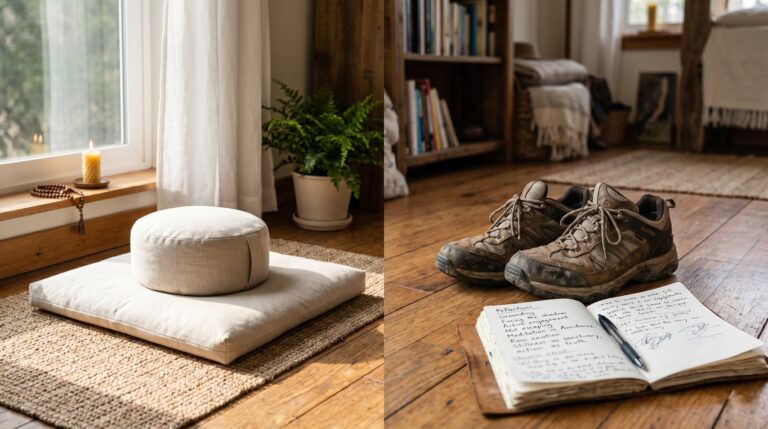
Same cushion. Same breath. A completely different direction entirely.
Want to explore meditation more? Check out practitioners offering meditation services in our Member Directory.